By Mawj Iyad in Baghdad //
On the outskirts of Baghdad, the landscape is shifting in ways that are impossible to ignore. Soil once rich and fertile is turning salty. Water sources are drying up or becoming too polluted to use. Smoke from refineries, burn pits and trash fires hangs low over villages, forming a grey ceiling that weighs on lungs and crops alike.
For thousands of Iraqi women who depend on the land, the environmental crisis is not an abstract policy debate. It is a daily erosion of income, identity and security.
Nouriya Matar, 54, has farmed on the outskirts of the Taji district, northern Baghdad, for decades. The income from wheat and melons sustained her family. But during the country’s conflict with the extremist group known as the Islamic State between 2014 and 2017, the main water supply to her land was cut and she has been forced to rely on wells ever since. The groundwater she’s using now is salty, Matar explains, and the soil has paid the price.
“Before planting brought in good money,” she recalls. “Now the water is salty, the branches are dry and there’s no profit. I tried many times but the wheat just won’t grow. So I finally decided to give up the land and sell it.”
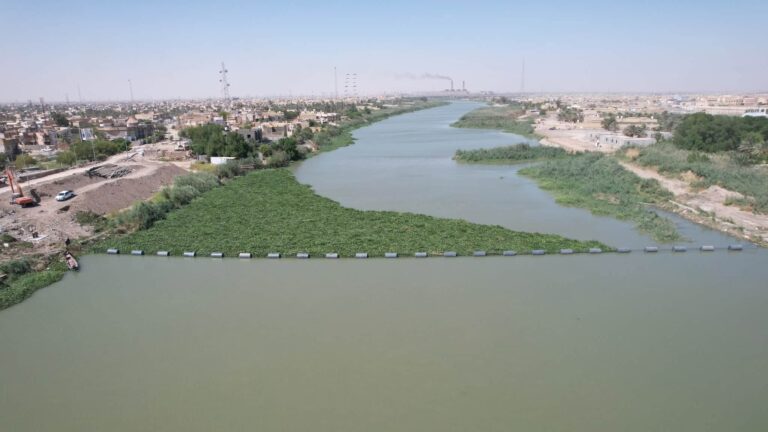
Matar’s is not an uncommon story. Water levels in the all-important Tigris river are dropping and farmers from Samarra to Baghdad are turning to small, unreliable streams and wells, which is accelerating soil salinity and shrinking harvests.
Environmental reports confirm that Iraq will be one of the countries in the Middle East most affected by climate change. And according to Iraq’s updated Nationally Determined Contributions report submitted to the United Nations in 2026 – the reports are individual climate action plans outlining how a country will adapt to climate impacts – nearly one in four working women in Iraq is employed in agriculture.
This makes females among the most exposed to climate‑driven losses.
In Arab Jabour, a district in the south of Baghdad, Sara Mahmoud Ali says she has been involved in agriculture since she was eight years old. She’s now 53 and has learned the intricacies of growing eggplant, cucumbers and okra. But she recently stopped working altogether.
“The earth is exhausted,” she says. “The crops don’t produce like before, and diseases are increasing. Even the livestock stopped producing. That has never happened.”
Ali says that leaving agriculture was like losing a piece of herself. It was not just her livelihood, she explains, but her independence and her identity.
At 78, Hida Subhi still works her land despite mounting losses. She estimates she has lost more than IQD30,000,000 ( US$23,000) over the past decade alone.
“The land won’t grow anything without help,” she says. “If we don’t use chemicals, nothing grows.”
Today her only steady income is a modest social welfare payment.
Pollution only complicates things further. In some areas, it’s not just water and soil impacted, it’s also the atmosphere.
For example, in eastern Maysan, near the Hawizeh marshes, the expansion of oil operations has brought constant gas flares and toxic emissions. This sort of pollution makes things even worse for women who work long hours outdoors.
Saadiya al‑Jubouri, 39, believes pollution contributed to her mother’s death. “She struggled to breathe, she carried her inhaler everywhere,” she says.
Government officials describe climate change and water scarcity as existential threats. Iraq’s Ministry of Environment says it has plans to reduce emissions and improve resource management while the federal Ministry of Agriculture talks of modern irrigation and “smart farming” in the long term.
But rural families say they can’t wait much longer. If a single season fails, it can push a household into debt.
As natural resources decline and environmental risks grow, one question hangs over women in Iraq’s rural communities: How do they survive in a country where natural resources are declining and environmental risks grow daily?
This article is part of a series funded by the “Qarib” program, an initiative of the French Development Agency (AFD) and the French Agency of Media Development (CFI).
Your opinion on this topic is important to us, you can comment directly on our social media pages and you can contact us via email or WhatsApp.
Related articles