By Nagham Makki in Basra //
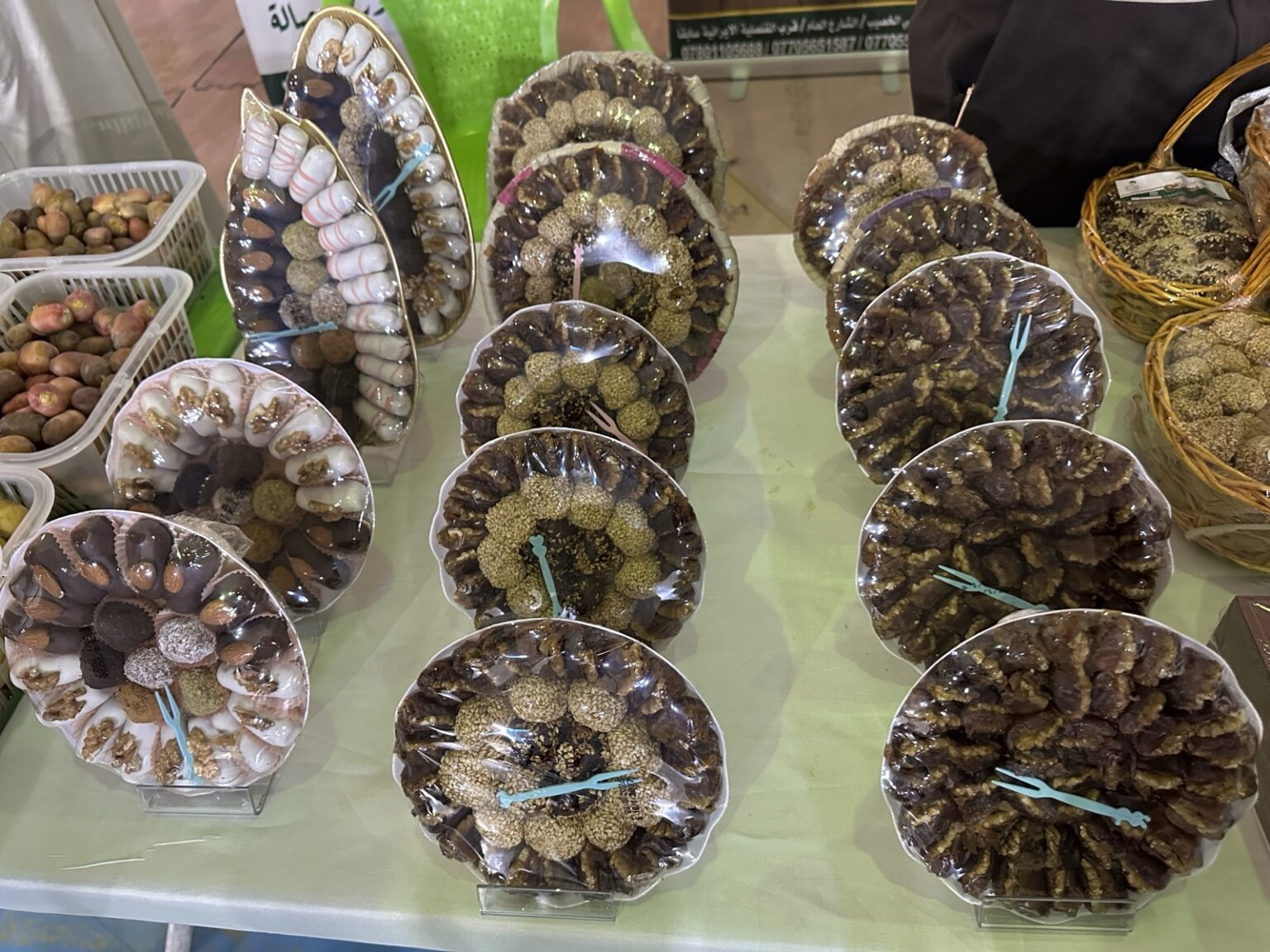
At the Youth and Sports Forum in Tannumah, on the eastern bank of the Shatt al-Arab in Basra, traditional bamboo baskets are overflowing with different varieties of dates. They sit alongside elegant boxes of dates coated in dark and white chocolate or stuffed with almonds and walnuts.
This is how visitors to the third annual Fresh Dates and Date Exhibition, were welcomed at the around 3,000 square meter large venue in September. The event’s motto: “Our Palms, Our Wealth”.
It’s the third time this event has been held and it’s likely the only such event in Iraq dedicated specifically to the date industry, one insider pointed out. This year around 25 exhibitors are participating, including farmers, factory and date-press owners and craftspeople.
All across the exhibition there seemed to be two main streams of activity around dates, one more traditional and the other more contemporary. The first belongs to a generation associated with date presses and traditional production methods. The other is attempting to transform dates into a modern confectionery product, using chocolate, nuts and sophisticated packaging.
Local producers are experimenting with ways to combine what consumers already know with products they hope can open up new markets.
Nahidh Hassan stands beside products he started developing around 18 months ago. He says his ideas grew out of visits to Gulf countries, where he observed how producers processed, packaged and presented dates, he says. Hassan has been trying to take a similar approach in Basra, importing machinery from Turkey, China and Iran.
“I saw how Gulf countries deal with dates and present them at the standard they deserve,” Hassan says.
His factory primarily uses one kind of date variety for chocolate-coated and nut-filled products. Hassan says the thin skin of the Bareem date, its low fibre content and firm texture, make it particularly suitable for this kind of processing. The date can be sliced lengthwise and pitted without losing its shape and chocolate sticks smoothly to its surface. The date’s natural sweetness also contrasts with the bitterness of darker chocolates.
Hassan’s factory employs between 15 and 17 staff to package and wrap the dates while three employees handle deliveries, transportation and direct sales. Hassan has also employed somebody to handle promotions on social media, something he now considers essential.
But developing a more sophisticated product can also bring problems. Basra’s intense heat can quickly damage the chocolate and packaging materials because refrigerated retail display is limited in Iraq. There is also the challenge of persuading local consumers to pay higher prices for dates, especially when compared to the price of chocolate in Iraq.
“People just don’t accept it,” Hassan notes.
Nearby Mustafa Abdul Latif is representing an older family enterprise at the event, established in 1991 and focusing on pressed dates.
The company later expanded into date paste and pastries filled with walnuts and nuts, then coated with sesame, tahini or coconut. According to Abdul Latif, the shift towards more modern packaging began around 2010. The business now provides a source of income for more than 300 families, he boasts.
But his smile fades when the conversation turns to the quality of recent harvests. “Natural conditions have affected the dates, from salinity to the weather,” he says.
Efforts to diversify Basra’s dates are not limited to small or family-run businesses.
Saleh Shaddad al-Faris, director of the Al Faris Company, one of the exhibition’s sponsors, says his company’s support of the event is part of its broader activities in the agricultural sector. These also include providing plants and agricultural engineers and advisers as well as supervising orchards. He believes there’s also a future in expanding retail packaging and processing dates into products such as vinegar and extracts.
This event is held in September because it’s the time of year when mature dates ripen, explained Lubna Jawad Najm, a senior engineer at the Basra agriculture directorate. That means farmers can showcase their best harvest at the height of the season.
Najm says this is a great place to get updates on contemporary date farming in Iraq. She notes that, beside processing and packaging, local farmers are also experimenting with date varieties from outside Iraq, using imported tissue-cultured seedlings to test how well they adapt to local soil and climate.
Still, none of that can conceal the difficulties of this year’s harvest.
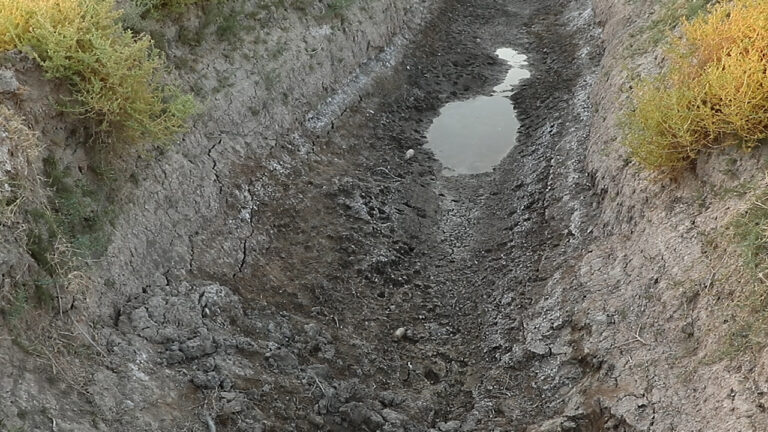
“For two years, we’ve had salinity and water shortages so the quality of dates this year isn’t what it should be,” Najm explains.
Around her, visitors negotiate prices as vendors rearrange their displays, traditional bamboo baskets beside polished chocolate boxes, and familiar Basra date varieties beside the newcomers still being tested in local orchards.
Among the visitors is Alaa Abbas. She moves from product to product, examining some closely and passing over others. After tasting a sample of a pistachio-filled date, she decides to buy it. “Some are worth the price, some aren’t,” she explains. But this year’s exhibition is better than the last year’s, she adds, before moving on to sample a tahini-filled date.
Your opinion on this topic is important to us, you can comment directly on our social media pages and you can contact us via email or WhatsApp.
Related articles