By Nagham Makki in Basra //
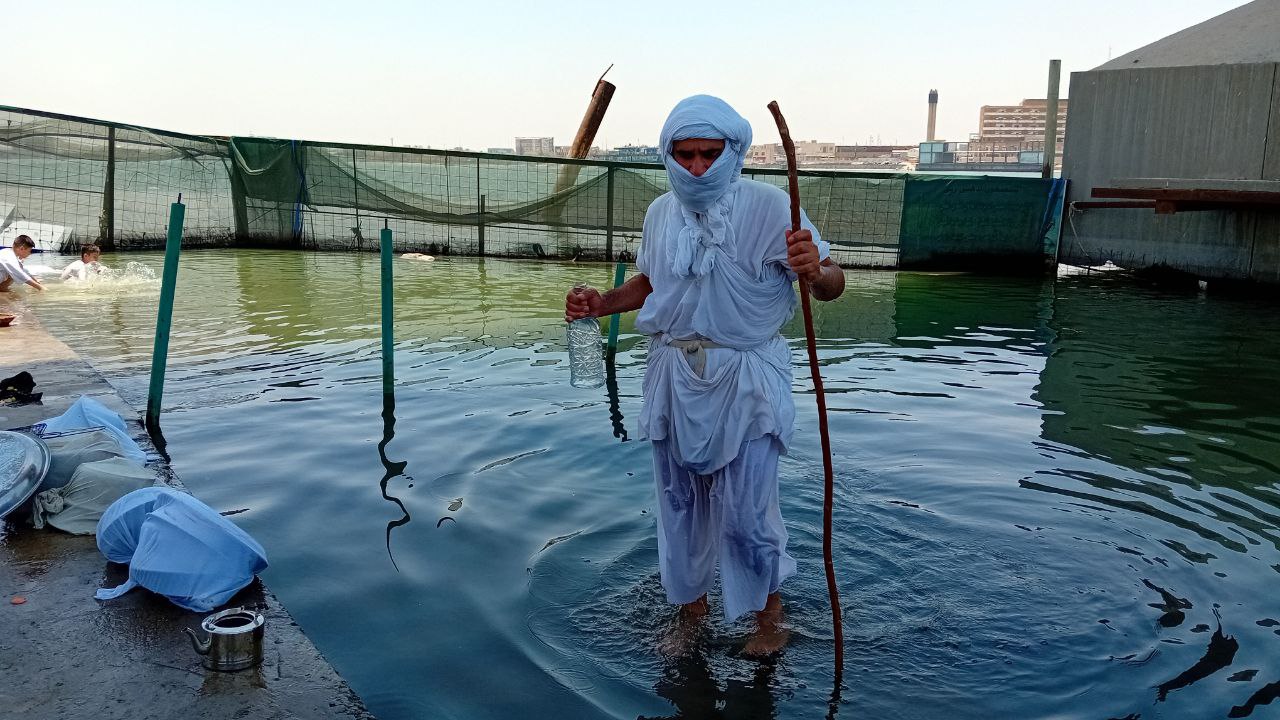
On a quiet morning along the banks of the Shatt al-Arab, beneath a bridge, Mazen al-Naif, the spiritual leader of the Mandaean religious community in the southern province of Basra, steps into the water wearing the traditional white garments of his faith.
The “rasta” robe clings to the 55-year-old’s legs, the woollen “hamiana” belt is tied firmly around his waist and he holds the “markna” stick made out of olive wood.
Baptism — repeated immersion in “living water” — is at the core of Mandaean worship and is performed for all kinds of events including births, marriages, weekly purifications and major religious holidays. Without clean, running water, the rituals cannot be performed. And without the rituals, the faith itself cannot continue.
The Mandaeans, one of the world’s oldest monotheistic religions, have endured a long history of displacement. In Iraq, their numbers fell from more than 60,000 in 2003 to an estimated 7,000 to 10,000 adherents today. Many fled sectarian violence after 2003, others left because of economic hardship or the collapse of public services. But in recent years, a new threat has emerged: climate change and its impact on Iraq’s slowly drying rivers.
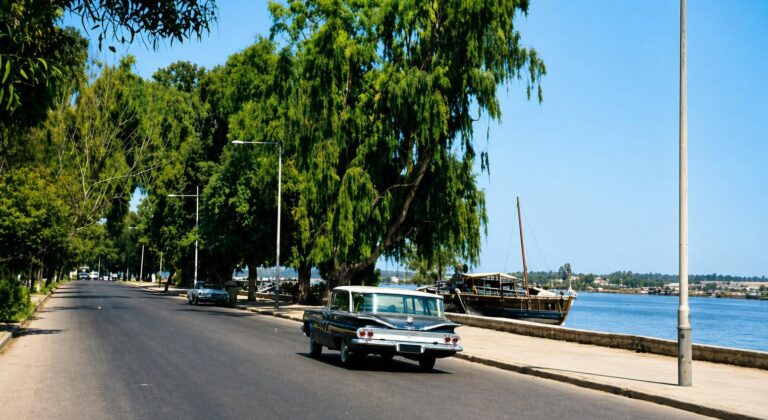
For centuries, the Shatt al‑Arab provided the perfect setting for Mandaean ceremonies. The river once surged with fresh water from the Tigris and Euphrates, pushing deep into the Gulf and nourishing vast palm orchards on both banks.
“In the 1970s, the river flowed with such force that families drank directly from it,” al-Naif recalls. “The water was clear, sweet and alive. Today the river is nearly unrecognizable.”
Southern Iraq is warming faster than much of the world. Rainfall has decreased, upstream dams have reduced river flow and seawater has intruded deep into the Shatt al-Arab, as the force of sweet water lessened. In central Basra, the water is almost half as saline as seawater now. More than 600 streams in the province are polluted, filled with sewage and industrial waste.
Among those is the waterway in Tuwaisa, in Basra province, which was once a popular site for Mandaean rituals.
“We used to gather there every Sunday,” al-Naif recalls. “Men in white garments, women carrying their newborns, the sound of prayers in our language. The water was cold and pure. It felt like the universe was breathing.”
Now the waterway at Tuwaisa has become a small, foul-smelling stream choked with garbage.
Faced with the collapse of local waterways, the Mandaeans built a temple complete with artificial pools designed to simulate flowing water. Pumps circulate and refresh the water continuously, meeting the section’s requirement for “living water”. The solution is technically valid under Mandaean religious rules but al-Naif considers it an unhappy compromise.
Inside the temple, known as a “Mandi”, the atmosphere is calm. White-clad worshipers gather around the pool as al-Naif recites prayers. He dips each believer into the water three times for purification and renewal.
Al‑Naif spent years studying holy texts, learning the Mandaic language and mastering the rituals that define the faith. He was only appointed to the leadership role four years ago, after numerous assessments and tests. Today he bears the burden of his shrinking community.
Al-Naif says he can imagine that by 2050, the Mandaeans will be gone from Iraq altogether. “If the drought continues, there will be mass migration,” he says. “We will search for water in neighboring countries.”
Younger Mandaeans increasingly choose to emigrate, seeking stability and clean water elsewhere, he points out.
Al‑Naif has even proposed drilling wells to access groundwater, which is also considered “living water” by Mandaean belief. If successful, it could provide a sustainable source for rituals even as surface water disappears.
But groundwater is not guaranteed. Over‑extraction, salinity and contamination also threaten groundwater reservoirs in southern Iraq. And drilling wells requires money, something the small community struggles to secure.
“We must try,” al-Naif insists. “We cannot abandon our land without exhausting every possibility.”
Today, as he sits beside the artificial basin in the temple, watching the water circulate, the beleaguered spiritual leader reflects on the feeling of purity the formerly fast-flowing rivers once offered his community. These memories sustain him but memory alone cannot preserve his people’s place in Iraq. Their fate in Iraq now depends on things like international water agreements, regional cooperation, climate policy and the uncertain future of Iraq’s rivers.
This article was published as part of the Green Panther Project in collaboration with the Taz Panter Foundation.
Your opinion on this topic is important to us, you can comment directly on our social media pages and you can contact us via email or WhatsApp.
Related articles