By Nagham Makki in Basra //
I walk along the Shatt al‑Arab corniche to clear my mind and to take a few photos for one of the reports I’m working on. I search for a corner that might shield me from the unbearable summer sun but all I find are scattered palm trees planted along the walkway. They do not offer enough shade to stop and rest in.
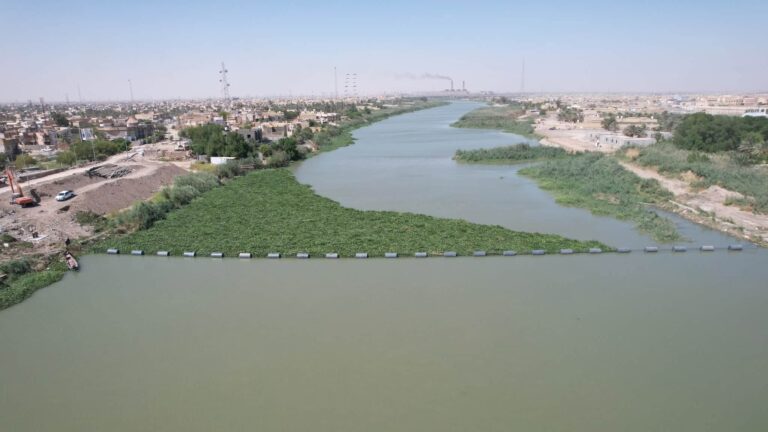
The corniche is one of Iraq’s most prominent landmarks: A road and walkway next to the Shatt al-Arab river in Basra. The river is formed by the confluence of the Iraq’s two great rivers, the Tigris and the Euphrates.
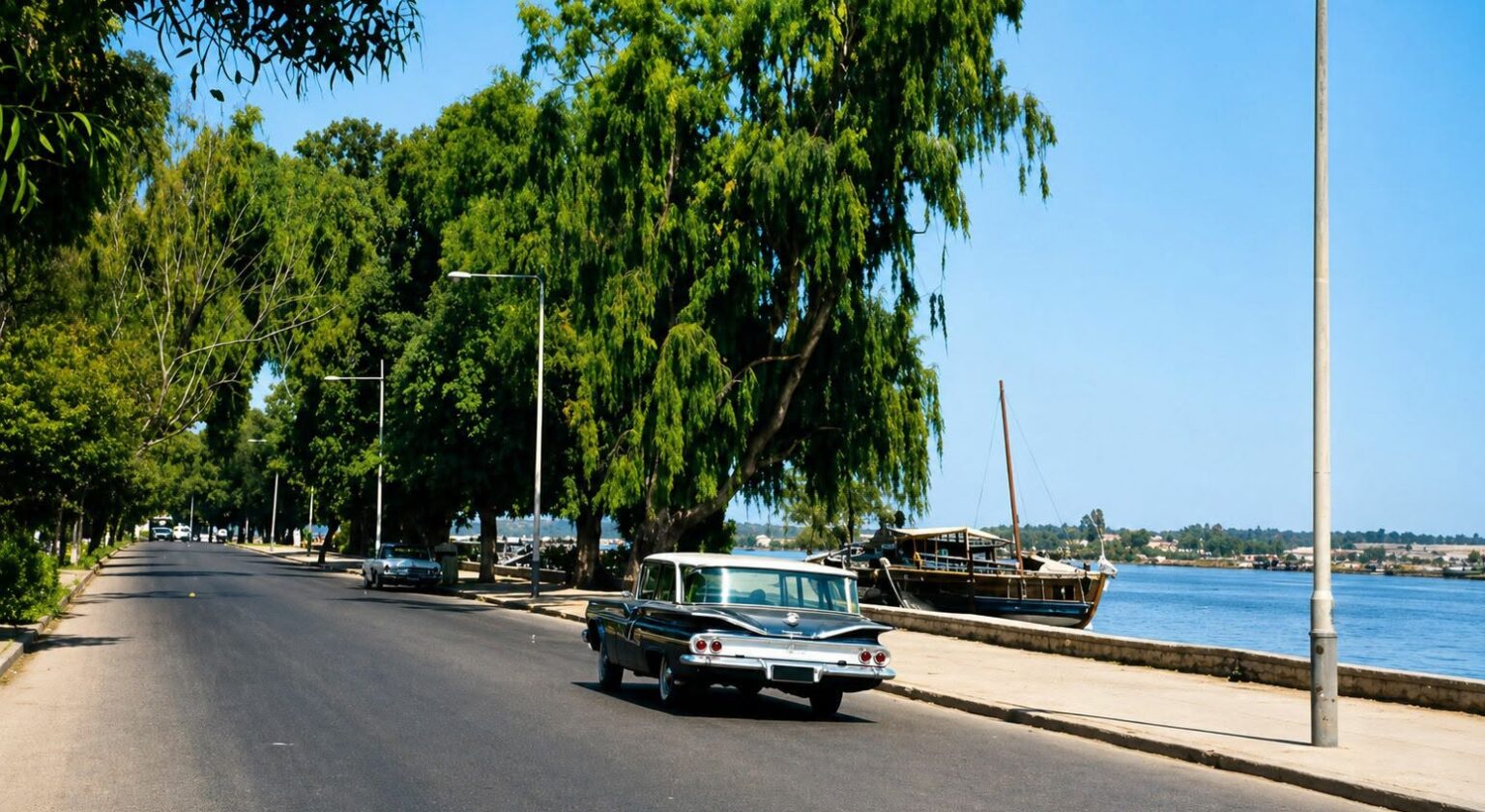
Around two decades ago, this path was sheltered by towering trees that cast broad shadows and helped ameliorate Iraq’s furnace‑like summer heat. Those trees have since been replaced by decorative palms and small decorative plants. Sure, the redesign gave the place a neat, urban look but it also stripped it of any shade.
I remember the trees from my childhood. We used to carry our bedding up to the rooftops, like most Iraqis did before air conditioning units took over our homes and the hum of generators disturbed our rest.
I would lie on the mattress after sunset, unconcerned by mosquito bites. I stared at the stars — celestial beauty we no longer see today — and whispered wishes about succeeding in school. Those nights were as clear as the sky itself.
I was especially fond of the Sidr tree, or Ziziphus spina-christi, a thorny evergreen that grows across the Arabian Peninsula, in my brother’s house, its branches spilling over the rooftop wall, dropping fruit on us like rain.
I used to climb that wall to pick fruit. My fear of falling was never enough to stop me. It only made me more determined. My love for that tree was so deep that it still appears in my dreams.
Then one day, without warning, the tree was gone. Its massive trunk no longer fit the narrow space. The tree that was blocking construction and was cut down. A room made of concrete blocks took its place. To me, the house seemed to lose a soul.
It wasn’t the first such loss. Our own garden was removed to build apartments when our house grew too crowded. My late mother used to tell us that the garden had been uprooted whole and replanted at a relative’s home, only to be removed once again for the same reason.
And this was no exception. It was a microcosm of what appeared to be a larger rule governing the entire city. When a tree stands in the way of construction, concrete always wins.
What we did to our tree and our garden, Basra did on a far larger scale when it erased Al Khoura Park, first opened in 1978 and once the largest green space in the city centre.
The park spanned roughly 163,000 square meters and was one of the city’s main recreational areas, free to families and a playground where children ran without limits or cost. It was demolished and replaced by a modern shopping mall.
Even the nearby nurseries were removed to widen the adjacent road.
A public space, owned by everyone, became a private investment and nobody ever even asked how this green refuge could be protected before the construction contracts were signed.
Wars, drought, water scarcity and urban expansion have transformed Basra from a city that once boasted Iraq’s largest belt of palm tree groves into a metropolis with a tree shortage.
I also remember Abu Saud, a kind relative, and the basket of dates he brought us every July and August. He carried the finest varieties proudly on his head, even though they weighed more than him.
Now most of the groves that produced Basra’s best dates have vanished, replaced by brick houses.
The number of palm trees here dropped from about 35 million in the 1970s to around 2.8 million today, although some palm tree groves have recovered in recent years thanks to volunteer agricultural initiatives.
Whenever I’m assigned to write an environmental report about such and such a grove or some green patch inside or outside the city, I can’t hide my joy. I once read that a human calms in nature because the wild creature inside them has finally returned to its original habitat. Maybe this is the reason for my joy.
Today, August, the fiercest month of the year, arrives with temperatures that regularly exceed 52 degrees Centigrade, all of which we endure with patience.
On the corniche, fatigue overwhelms me, nausea creeps in, but I push through, straighten my back and continue walking despite the sun.
I smile when I see a street filled with trees that must have been planted by residents, their branches spilling over fences and offering shade.
So I take a photo to keep as a memory. Perhaps I won’t see such a scene again. In Basra, trees are often uprooted silently and without protest. Their “casualty” numbers won’t make it into the news — even though maybe they should.
Your opinion on this topic is important to us, you can comment directly on our social media pages and you can contact us via email or WhatsApp.
Related articles