By Murtadha Al-Hudood in Dhi Qar //
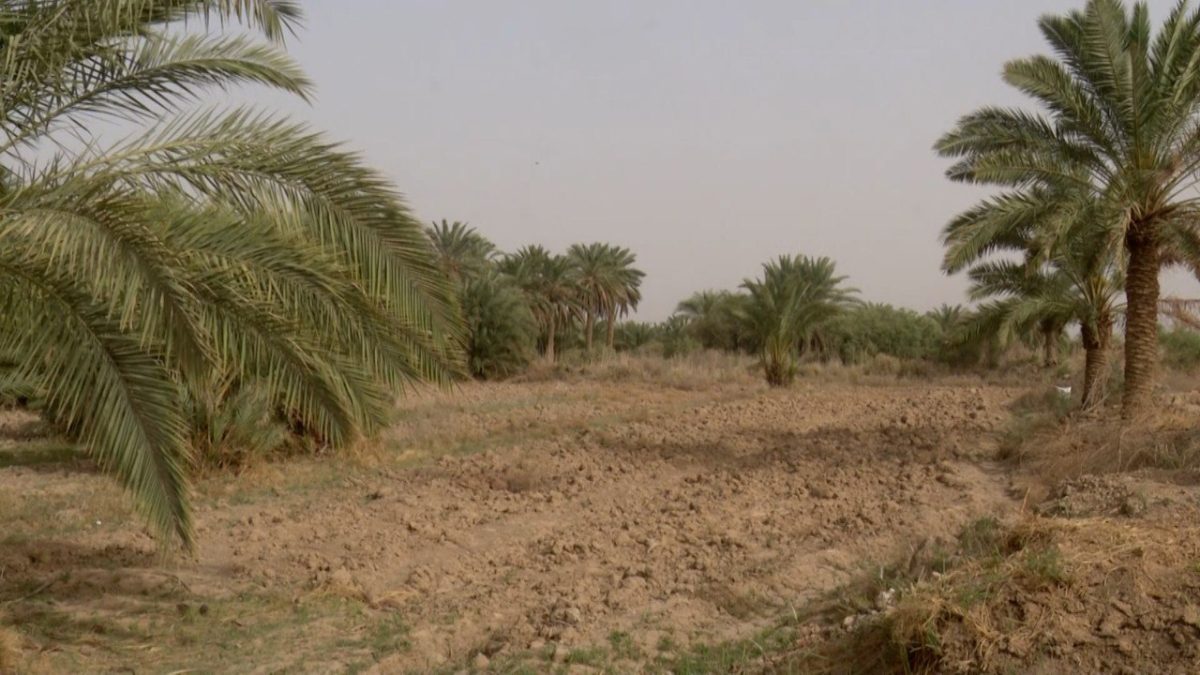
In his orchard north of Nasiriyah, a city in Iraq’s southern Dhi Qar province, Alaa Risan walks among date palms and summer crops, checking the soil and irrigating what he can.
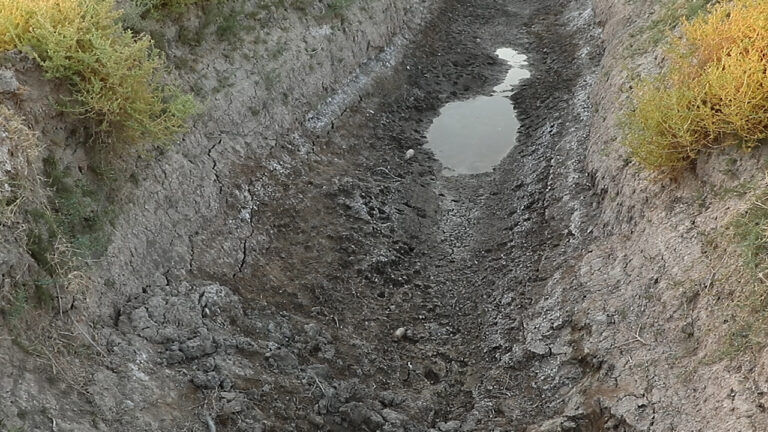
There is little water here and what does reach the orchard is pumped through a long plastic pipe.
Around two decades ago, Risan says the agricultural water for the area began to decline before some large pieces of farmland were totally cut off. Fields stopped producing and were later described as barren or unsuitable for agriculture.
For Risan, the problem was never the land. “The first blow we received was the loss of our water allocation,” he said. “We could no longer cultivate our land.”
But even as farming struggled, the nearby city of Nasiriyah was expanding. Urban development pushed into surrounding villages and farmland. Some areas were incorporated into the city’s master plan and designated for housing or investment projects.
Risan’s family owns about 20,000 square meters that have now been brought inside municipal boundaries. He still maintains a 5,000 square meter orchard of palms and seasonal crops but says it is being threatened by an investment project.
His experience illustrates two forces reshaping rural Dhi Qar: worsening water scarcity and the outward expansion of cities.
In Zuhairiya, a village west of central Nasiriyah, Mutlak al-Zuhairi faces a different problem.
A secondary-school teacher and farmer, Zuhairi says his village remains green and its land is cultivated every season. Yet the area has been incorporated into urban expansion plans.
According to Zuhairi, municipal authorities began surveying the village’s land back in 2019. Residents resisted, arguing that their farms were still productive.
He says the authorities subsequently used a drone survey to survey land they described as unsuitable for agriculture, which paved the way for its subdivision into residential plots.
But Zuhairi disputes that classification. The village, he says, contains cultivated fields, orchards, date palms and homes, most of which have been there since the 1970s.
“My land is 2,000 square meters large, and I cultivate it every season,” he said. “My father’s land is 11,000 square meters and it is also cultivated every season.”
For Zuhairi, the issue is more than an administrative change. It is a contradiction between what official classifications say about the land and what farmers see on the ground.
Official data suggests that the changing face of rural Dhi Qar cannot be explained by drought and migration alone.
Dhi Qar’s statistics department shows that the number of registered villages fell from 1,483 in 2009 to 1,445 in 2024, a decline of 38 villages, or about 2.6%.
But that does not mean 38 villages physically disappeared or were abandoned.
The department says part of the decline reflects expanding city boundaries and changes in classifications. A settlement can continue to exist while no longer being officially classified as a village.
The figures reveal something more complex. Water shortages have pushed some rural residents away from farming while expanding cities have absorbed others.
Research by geographers at the University of Dhi Qar shows the scale of the transformation around Nasiriyah.
Between 1970 and 2016, residential land in the city grew from 691 hectares to 5,631 hectares, an increase of more than 700%. Agricultural land, meanwhile, declined from 6,988 hectares to 4,866 hectares, a loss of about 30%.
Not all the lost farmlands were used for housing. The amount of barren land also increased sharply during the period. Still the figures illustrate the pressure surrounding farmland has been under as the city has grown.
According to Dhi Qar’s director of agriculture Awad al-Omari, one major housing initiative alone has taken up as much as 12.6 square kilometres.
Manar Majid, a geographer at the University of Dhi Qar, says consequences of this kind of development go beyond the physical loss of farmland.
Converting agricultural land into residential use reduces space available to farmers and livestock breeders, potentially weakening local food production and changing village economies. Farmers who lose access to land may have to search elsewhere for farmland and employment.
Urban expansion also puts pressure on green spaces and open land while requiring new infrastructure and public services.
The social effects can be significant too, Majid says. As villages are absorbed into cities, residents accustomed to rural livelihoods may find themselves adapting to different forms of employment and social life.
The result can be transitional communities that are neither entirely rural nor fully urban.
Whatever happens, it is clear that the relationship between local people and the land is changing.
Risan continues pumping what little water he can reach into his orchard, convinced the palms could flourish again if he can give them enough to drink while Zuhairi is determined to continue to cultivate his farm each season, even as the land surrounding it is being sucked into Nasiriyah’s urban expansion.
This story was produced and published in cooperation with Al-Mashhad Al-Yemeni.
Your opinion on this topic is important to us, you can comment directly on our social media pages and you can contact us via email or WhatsApp.
Related articles