By Salam Hanadni in Halabja //
In the countryside that stretches between Halabja, Hawraman and Penjwen in the semi-autonomous northern region of Iraqi Kurdistan, danger lies under the soil.
Decades after the end of the Iran-Iraq war, landsmines and unexploded armaments continue to threaten ordinary people there.
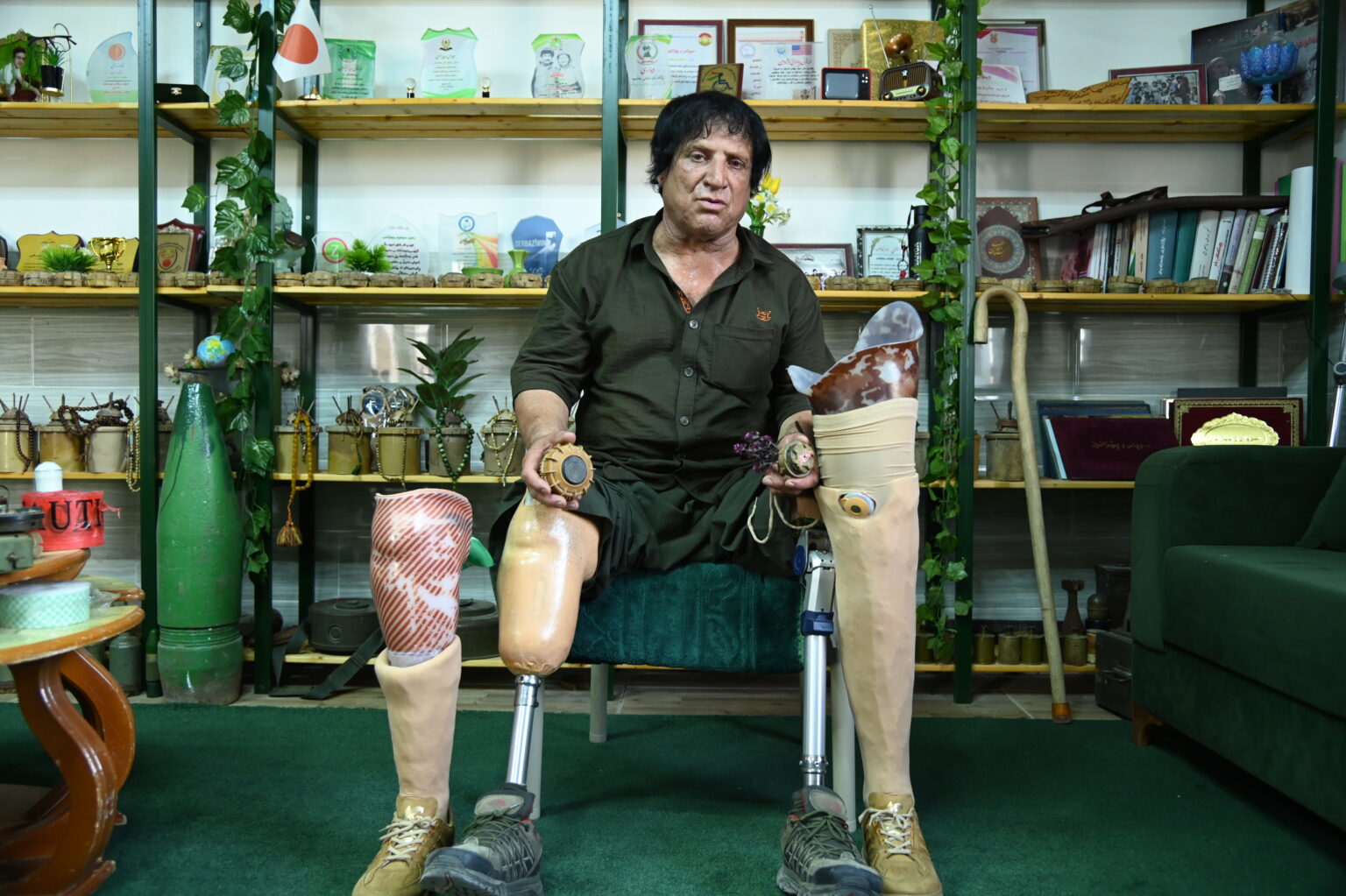
Hoshyar Ali Biaweli, who’s known around the region as “Hoshyar the minesweeper” has devoted himself to eradicating this danger. He has already paid a heavy price for his work: Two separate explosions took both of his legs.
Now aged in his 60s, Biaweli has spent more than 35 years doing this work. He started when he joined the local Kurdish security forces, the Peshmerga, and trained in mine detection and removal. He has since become one of the area’s most experienced mine clearance specialists.
In 1989, an explosion during a mine‑clearing operation cost him his first leg. A few years later, another blast took the second.
One of the most painful moments of his life came in 1994. Residents of Penjwen had asked him to clear the minefields threatening their community. However, the next day tragedy struck — his only son died.
Still, even in the face of unimaginable grief, Biaweli chose to honor his promise and traveled to Penjwen instead of staying at the funeral. “These mines must be removed so others don’t lose their children the way I lost mine,” he said.
His work has also taken him outside of Iraq. He has received advanced training in mine detection and explosive disposal in Japan, with the support fo the Japanese government. There, he was also equipped with artificial limbs that allowed him to continue working.
Today Biaweli uses sophisticated Japanese-made devices capable of detecting metal objects buried up to 1 meter deep. Once a suspicious object is located, it begins the delicate process of neutralizing or safely detonating the mine, depending on its type and risk level.
During fighting against the extremist group known as the Islamic State, or IS, Biaweli helped clear areas that the group had left. The extremists left behind many booby-trapped explosives.
Over the course of his career, he has neutralized more than 2,386,000 mines of various kinds and helped clear approximately 540,000,000 square meters of agricultural and residential land. He has also saved 160 people who were trapped or endangered by minefields.
Residents of Hawraman often speak about the impact of his work. Local man Mohammed Jamal says around 10 people in his community have been injured by mines over the past three decades, in addition to the loss of livestock. But Biaweli has repeatedly visited the area and removed mines. He is selfless, Jamal says.
In his own village, Biaweli’s house has become something of a museum. Inside his home and even in his car, he keeps hundreds of examples of the deactivated mines, shells and explosives he has collected during his career. He says the purpose is not to show off what he’s done but to teach future generations about the deadly nature of war.
Behind his home there is also a large pit that contains more than 10 tons of no-longer-dangerous armaments.
Biaweli has dedicated himself to raising public awareness about mines as well. He has visited more than 600 schools in Iraqi Kurdistan. Using photos, videos and real examples, he teaches children how to recognize suspicious objects and avoid danger, and he stresses that knowledge and caution are the best defense.
His mission has left a mark on communities across the region, schools, and public facilities have been named in his honour. For Biaweli, saving lives is a lifelong commitment.
Your opinion on this topic is important to us, you can comment directly on our social media pages and you can contact us via email or WhatsApp.
Related articles