By Nagham Makki in Basra //
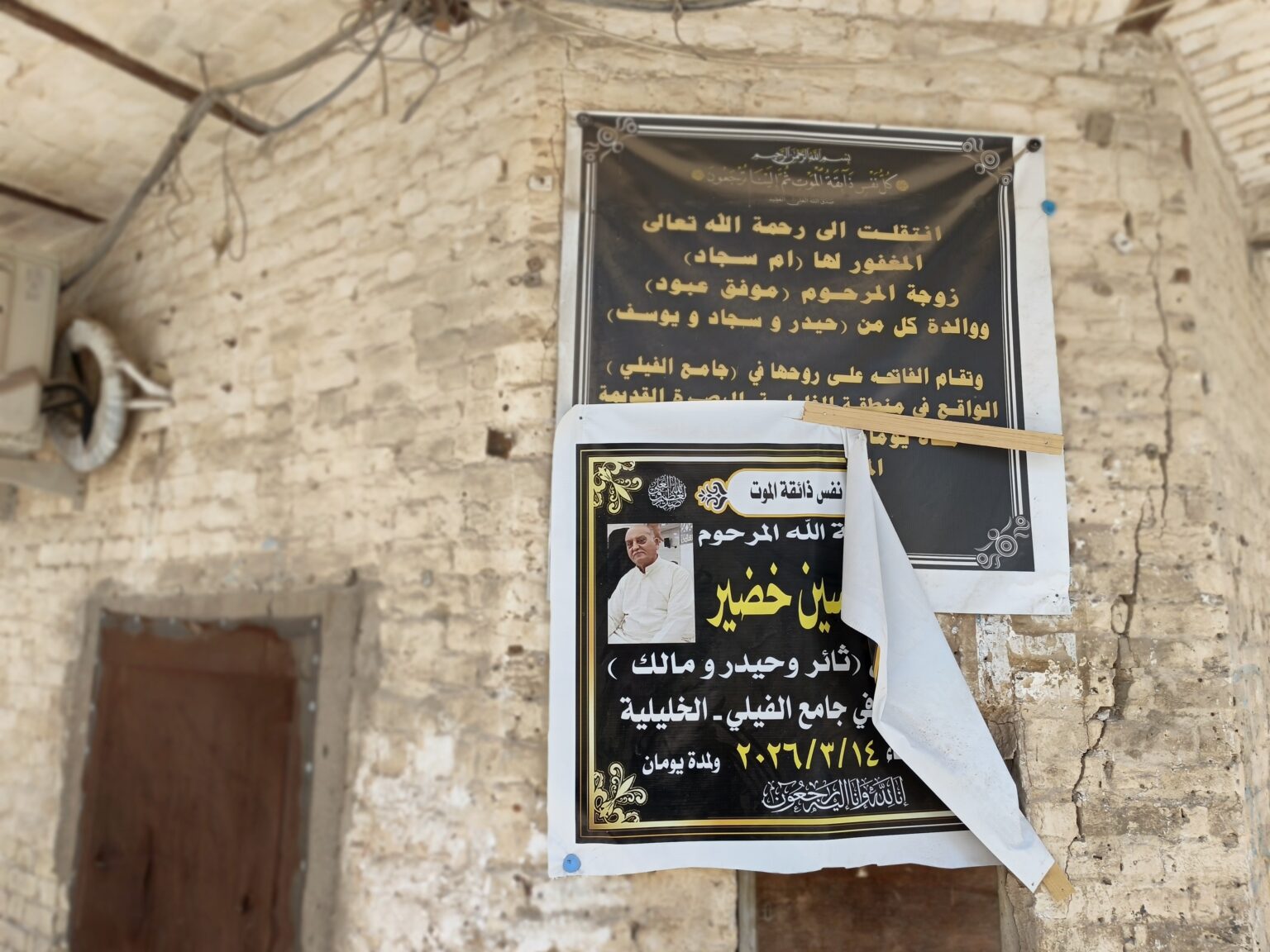
A black mourning banner hangs on the brick wall inside this Basra home. The banner lists the names of a deceased woman’s sons, one after another.
But the recently deceased woman’s name isn’t on the banner. She is only identified as “the mother of …” as though she doesn’t deserve a spot on this list.
In the blank space where a woman’s name should have been written, an entire life disappears — a life lived and lost on the margins.
“They don’t accept it,” explains Um Ghayeb (or “mother of Ghayeb”), as she holds black prayer beads, sitting at the edge of a group of women all dressed in black at a popular Basra shrine. A woman’s name must be kept private, she insists, because it not only represents the individual but also the entire family. A woman is a shadow of a man, and her name must not stray into public space, she suggests.
She herself prefers to keep her real name hidden, she admits.
“Some people will exploit a girl’s name,” Um Ghayeb argues.
Her explanation reflects the belief that a woman’s name can be misappropriated, especially when it comes to superstitions or black magic.
Meeting with Abul Amir Khalil, a Basra man in his 60s, it is a similar story. Does he mention his mother’s name in public?
“There’s nothing wrong with it,” he says, after hesitating briefly. “But some people fear black magic. A mother is a focus for magicians. Her name is the entry point.”
In fact, Khalil says he had a relative who was targeted by black magic and believes the spell took hold because the mother’s name was used. “We saw how it affected him. This is not just talk.”
However, Khalil has a different take when it comes to his wife’s name or his daughter’s. He says he speaks about them normally although he adds, he won’t often mention his wife’s name outside the house. On the other hand, Khalil believes not mentioning a female name in an obituary is an ignorant practice.
For Ashwaq Talib Mansour, a women’s rights activist, the erasure of a woman’s name is not only a social tradition, it is also political.
In politics, many female candidates use their husband’s tribal title instead of their own names on campaign posters, she explains. “If her husband is a well-known sheikh, she thinks his name will bring more votes. A woman runs under someone else’s name to win. And then if she wins, the victory is credited to the man behind her.”
Hanaa Maad, a Basra local in her 30s, sees the issue from a business perspective. She opened a small beauty salon under a false name. But she says, “it wasn’t about hiding my identity. A unique name attracts attention and brings more customers.”
But she notes there are also other reasons. “Some families avoid shops that carry a woman’s real name, out of tradition or concern for her social status,” Maad continues.
For widows or divorced women, she says, the challenge is even greater. “Their names become vulnerabilities. A commercial name removes suspicion and helps the business succeed.”
Most of his friends know his mother’s name, says Mustafa Rahim, a Basra local in his 20s. “The reasons [why somebody might not reveal their mother’s name] vary,” Rahim believes. “Jealousy, honour, tribal customs or fear of witchcraft!”
Civil society activist Sundus al‑Zubaidi sees the practice as something inherited through culture, rather than intentionally misogynist, even if it is harmful to women’s presence and identity.
She thinks change should begin with everyday customs, for example, in locations, wedding invitations, condolence cards and online posts. “When you write her name, just as you write his, you’re not doing anything extraordinary. You’re simply acknowledging that she exists,” al-Zubaidi posits.
Basra social worker Safaa Hussein calls it an “auditory taboo” that is meant to prevent “imagined embarrassment.”
But it can also be dangerous, Hussein points out. “In inheritance disputes, some men avoid mentioning their sister’s name, which makes it easier to take her share or pressure her to give it up. Erasing her name paves the way for erasing her rights.”
On Al Farahidi Street in Basra, a street lined with bookstores, often referred to as the counterpart of Baghdad’s famed Mutanabbi Street, Tawfiq Yaqub al-Jazaeri is arranging books on a stand.
Al-Jazaeri, who is a member of the Basra Writers’ Union, says the erasure of women’s names is a phenomenon much older than the current debate.
“This issue is as old as pre-Islamic times,” he recounts. “We are a tribal society governed by customs and these customs have long treated women as shameful somehow. Although women today have gained freedom through work and public life, some things are still the same, including this reluctance to mention their names.”
He cites sociologist Ali al-Wardi, who said, “social life is merely a web of reciprocal hypnosis where people hypnotize each other without ever realizing it.”
Al-Jazaeri says he has no problem mentioning the names of his mother, wife or daughters. “We openly mention the names of the Prophet [Mohammed]’s wives and daughters — Fatima and Zainab — day and night. But with our own women, we whisper. It’s social hypocrisy.”
Your opinion on this topic is important to us, you can comment directly on our social media pages and you can contact us via email or WhatsApp.
Related articles