By Murtada Al-Hudood in Dhi Qar //
Dawn on the Euphrates River in the southern Iraqi city of Nasiriyah. Fisherman Abu Hussein pushes his small wooden boat into the water. For years, he has made this journey, searching for the best place to cast his nets.
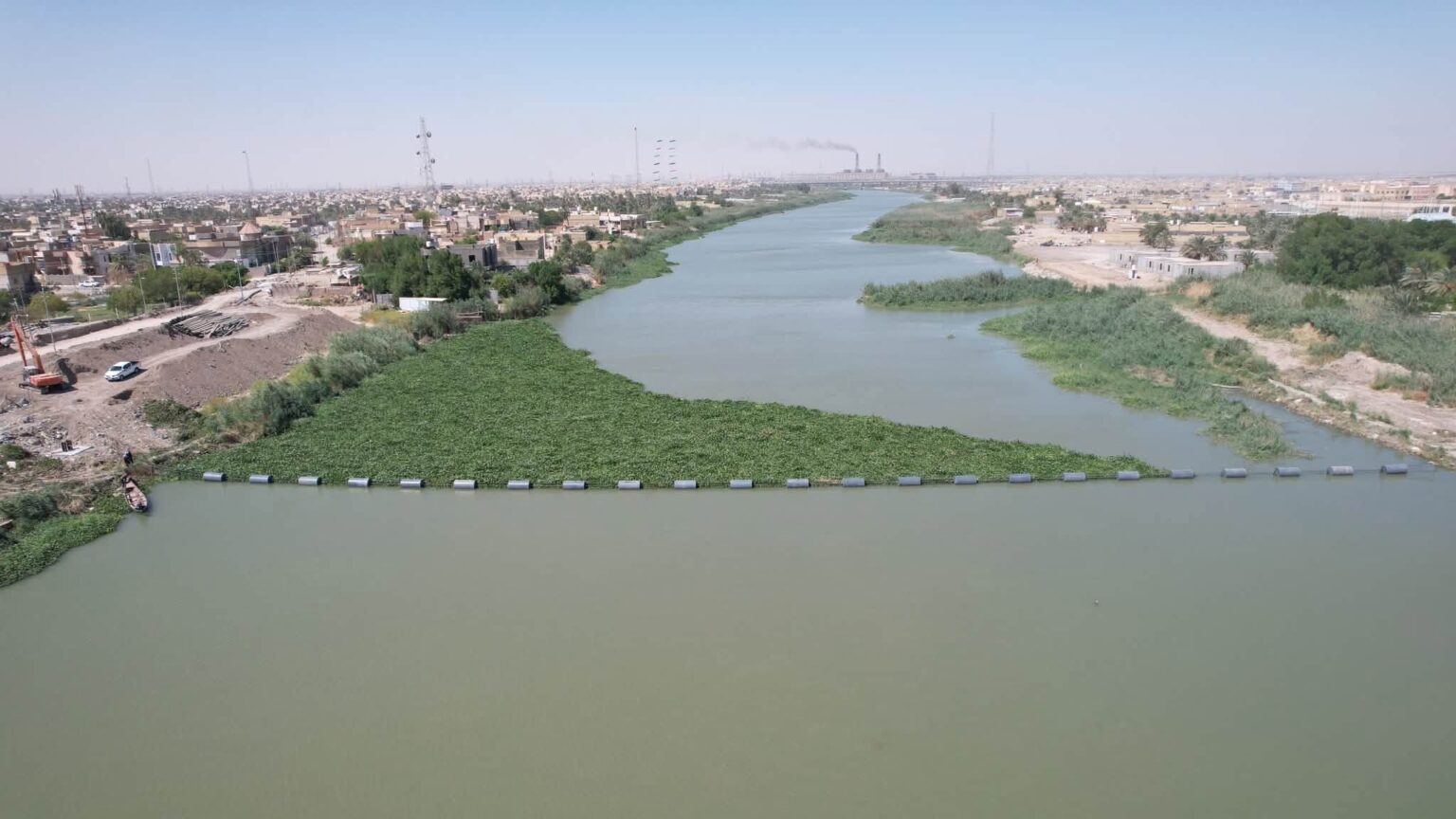
More recently though, his fishing trips have changed. Large floating mats of water hyacinth, often called the “Nile flower”, blanket sections of the river forcing fishermen like him to steer through narrow channels cut between dense clusters of vegetation.
“We used to travel much farther and fish in several locations,” Abu Hussein says. “Now we spend our time looking for pathways through the plants because huge parts of the river are covered by it.”
Despite the poetic name, the water hyacinth is an invasive pest on Iraq’s rivers. Originally it came from South America’s Amazon basin as an ornamental plant, introduced in Iraq two decades ago. But today its leaves form a thick cover over Iraq’s rivers, absorbing up to five litres of water per plant a day.
Saleh Hadi, an expert with the Dhi Qar agricultural directorate says the expansion of water hyacinth is closely linked to rising temperatures.
The plant begins growing rapidly during spring and reaches peak density during Iraq’s blazing summer months. High temperatures and still or slow-moving waters provide ideal conditions for its spread.
In a country already struggling with reduced river flows, rising temperatures and chronic water scarcity, the amount of water the plant needs is concerning.
The water hyacinth’s dense coverage also slows water movement and can restrict the delivery of water to canals and irrigation systems.
As thick layers of water hyacinth spread across rivers, they block sunlight from penetrating the water below. Reduced light affects aquatic ecosystems and can lower oxygen levels, harming fish populations and other organisms that depend on healthy water conditions.
The water hyacinth can also create a habitat for pests, disease vectors and even snakes, extending the problem beyond waterways into nearby communities.
So what appears at first glance to be a harmless green carpet floating on a river is actually the trigger for a chain of negative environmental consequences.
Authorities in Dhi Qar have been battling the water hyacinth for years. According to the province’s Directorate of Water Resources, more than 502,000 square meters of the plant have been removed from the Euphrates and Gharraf rivers this year.
The campaign in Dhi Qar is part of a national effort to contain the invasive species. Iraq’s Ministry of Water Resources has allocated IQD5 billion ($3.8 million) for water hyacinth removal projects and also deployed teams to clear the plant from the Tigris and Euphrates rivers.
In other countries where the water hyacinth has caused problems — including Uganda, Kenya, Tanzania, South Africa and Sudan — governments have used weevils that feed directly on the water hyacinth. While results took years, supporters of the idea argue that biological control can provide a more sustainable long-term solution than repeated mechanical removal.
At the moment Iraqi authorities are mainly installing barriers, clearing waterways and trying to prevent the plant from spreading between river systems.
The clearing operations cost a lot of money and has experts asking another question: Is Iraq missing an opportunity involving the water hyacinth? Could this environmental burden be transformed into a useful resource?
Some suggest that the vast quantities of water hyacinth being removed from Iraqi rivers should not simply be discarded. Instead, they say, it could be processed and reused.
After collection, drying and shredding, water hyacinth can potentially be turned into organic fertilizer or incorporated into livestock feed. Such uses could help offset the costs of removal while creating value from waste.
The idea isn’t entirely new. In 2009, a small project in the district of Shatrah, north of Nasiriyah, experimented with producing organic fertilizer from water hyacinth waste collected from irrigation canals.
In 2019, Iraq’s Ministry of Higher Education and Scientific Research announced that a team from Mustansiriyah University in Baghdad had produced an organic fertilizer using a mixture of organic waste and water hyacinth.
The researchers collected plants from the Mishkhab River and tested various decomposition processes. According to the university, the resulting fertilizer achieved a germination rate higher than that of the commercial fertilizer they were comparing it to.
Water hyacinth may also have potential in animal nutrition. A master’s thesis completed at the University of Baghdad in 2022 examined the possibility of incorporating the plant into sheep diets.
The study investigated whether processed water hyacinth could partially replace conventional fodder. Researchers concluded that, after appropriate treatment and testing, the plant could indeed be used within livestock feeding programs.
Although more research is needed, these findings suggest the water hyacinth could become more than a pest.
Unfortunately for fishermen like Abu Hussein, the issue is less theoretical. Every day, water hyacinth determines where he can travel and work.
Your opinion on this topic is important to us, you can comment directly on our social media pages and you can contact us via email or WhatsApp.
Related articles