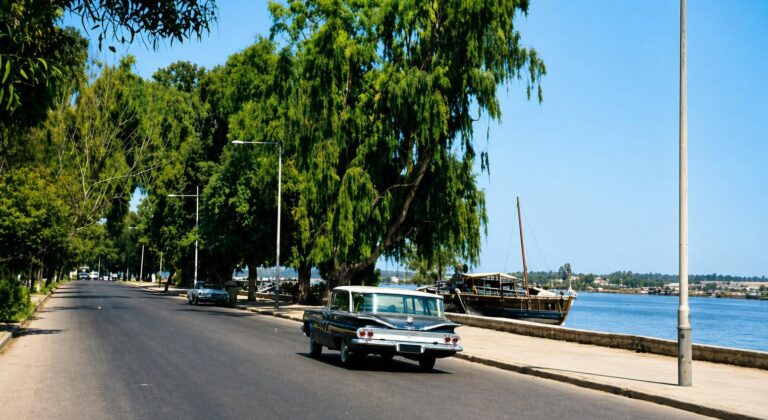
By Nagham Makki in Basra //
The radio once echoed through my late father’s room, it’s sound filling our home. He would grip it tightly, holding onto his link to the world, while I listened by the door, anxious.
Back then, our house had become too small. The war [when the US invaded Iraq in late March 2003] meant that everyone — adults and children — had to squeeze into the living room together. My father thought it better that we face death together rather than being safer but apart. We didn’t agree but fear made us accept his reasoning. In those moments, logic felt like a luxury we couldn’t afford.
The war meant school stopped and I was relieved at first. No more exams or the principal telling us all that we were going to fail.
That relief didn’t last long though. I would listen to news presenters talking about how Iraqi soldiers were withdrawing, listing the wounded and the dead describing, homes struck by missiles and also schools that no longer existed.
I felt fear slip into my heart.
I would get these strange longings for school desks, books, exams, even for those daily warnings from our headmaster. If you look at history, you see that education does continue after wars end and that gave me some hope.
Schools reopened and classes resumed in May. We were to finish the remaining curriculum and take exams in June. Most subjects stayed the same but one, “national education”, was gone following the dissolution of [Iraqi dictator Saddam Hussein’s] Baath party and the appointment of a new school principal.
Despite all that seeming comparatively normal, there were some unexpected changes. At school, it was clear that more girls were wearing the hijab [a scarf which covers the hair].
A lot of students began wearing it, not necessarily out of personal or religious conviction, but often due to concerns about safety and due to societal pressure. The hijab was a way of blending into the background, preventing unwanted attention.
Teachers, who had previously not covered their hair or had perhaps worn more tight-fitting clothing, also changed their look in those weeks.
Nobody asked questions and nobody offered explanations. Everybody knew why those changes were happening. We didn’t have to talk about it.
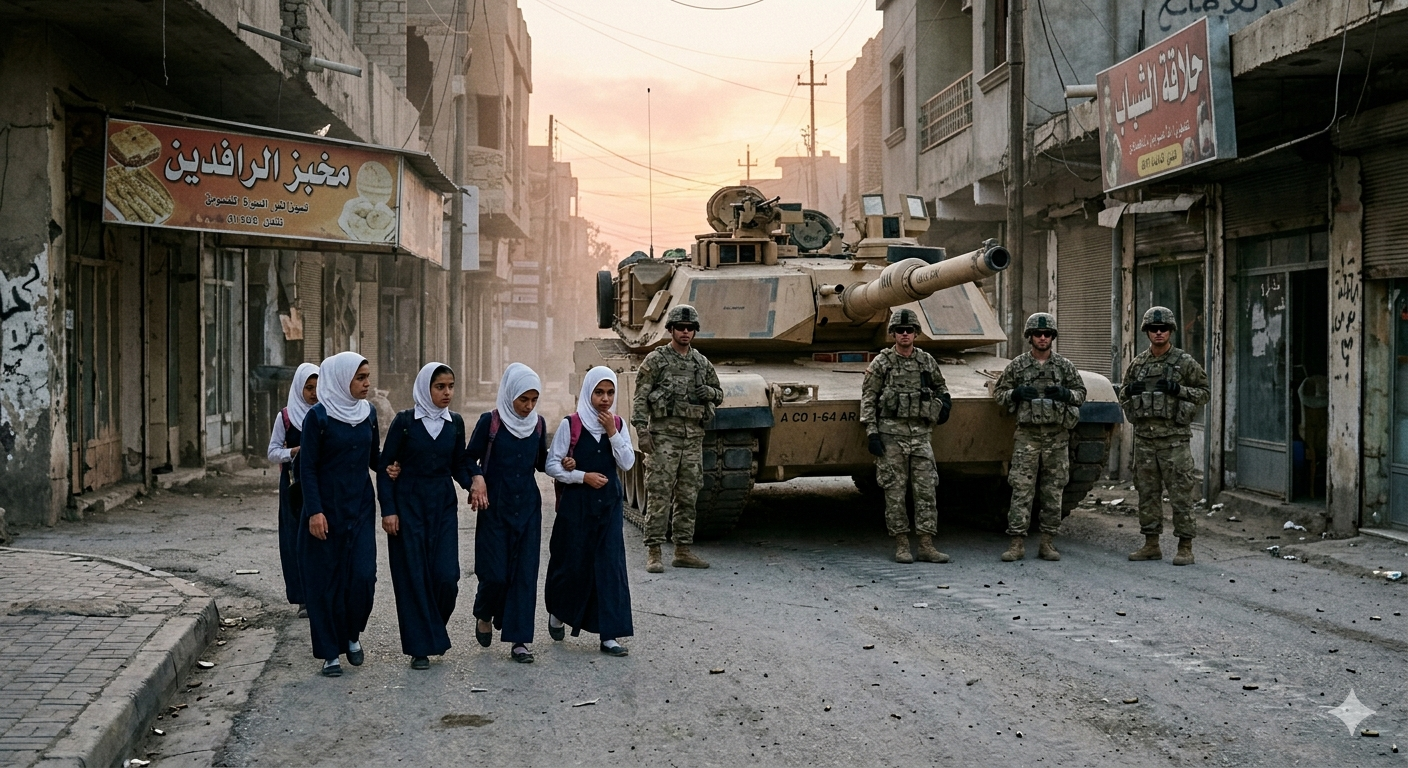
On our way to school, tanks driven by the British military patrolled the streets of Basra. Their approach was often overwhelming and caused uncertainty. We didn’t know how to respond or act.
Soldiers stood beside the tanks with their weapons and dark sunglasses.
Rumors spread that those sunglasses could see through clothes! No one knew if that was true but the rumor alone was enough to double our fear. We lowered our heads and walked on, as if looking at them was a crime, or walking with confidence was an accusation.
One morning, I saw a British tank blocking July 14 street. I paused, unsure if I should go forward or head home. The soldiers showed no emotion.
Although nothing happened, that day stayed with me longer than days spent under bombardment. A missile comes and goes but it is the silent fear haunting your own street, that is most intense. That psychological battle was heavier than the roar of airstrikes.
Under these circumstances, school attendance became a decision for families’ careful consideration each and every morning. Parents would wait with their kids for the school bus. There were rumors and reports about kidnappings and missing girls. We didn’t know if any of it was true but it affected our behavior anyway.
I remember a classmate who used to sit near me when I first started secondary school. She was remarkably beautiful, with an unforgettable smile. She stopped attending school after just one week, in the fourth grade.
She suddenly disappeared and rumors spread: Some said she’d been kidnapped and assaulted by American soldiers, others said she was married or dead or had committed suicide. What I really remember though is that she vanished and then it was like she never existed.
I also remember a neighbor of ours. She was always at the top of her class, a girl who memorized mathematical equations and explained them to others like a teacher, even though she was not yet 17. Her family decided she should leave school despite her high grades and I heard them say something I did not fully understand at the time: “What good is a diploma if America will ‘smash the girl’s face’?”
When I first heard that, I didn’t really understand it. It took me years to grasp its significance — how a crisis can make a woman’s body feel like a repository of worry, shame and fear; how, in certain, the threat of danger outside will outweigh the value of families education for their daughters. Knowledge doesn’t matter much to some people when honor is the measure by which everything is judged.
After 2003, everything changed. Freedom came to be measured by how many countless concrete barriers cut through neighborhoods and altered our city’s landscape.
The hope for education, once seen as a right, slipped quietly away for many girls in my generation, disappearing with little notice and no mention in headlines.
War records the casualties but it never accounts for the dreams we lost without a shot being fired.
Your opinion on this topic is important to us, you can comment directly on our social media pages and you can contact us via email or WhatsApp.
Related articles